Cambridge International · IGCSE · English Literature
Songs of Ourselves Volume 1 (Selected)
Songs of Ourselves Volume 1 is a vibrant, global anthology that spans centuries and continents, offering profound insights into the human condition. Studying these poems rewards close, critical reading, allowing candidates to explore how diverse voices use language, form, and structure to articulate complex themes of identity, nature, and social justice.
- 5 min read
- 2 worked examples
- 4 practice questions
- 8 key terms
Study Notes
Overview
Songs of Ourselves Volume 1 is a cornerstone text for the Cambridge IGCSE English Literature specification. It presents a curated selection of poetry from across the globe, challenging candidates to engage with diverse voices, historical periods, and poetic forms. Examiners are looking for a sophisticated, personal response that demonstrates a deep understanding of how poets craft meaning. You must move beyond simply identifying techniques (feature spotting) to analysing their specific effects. Furthermore, integrating contextual knowledge—understanding how a poem's historical or cultural background shapes its meaning—is essential for accessing the highest mark bands.
Listen to the Podcast

Themes
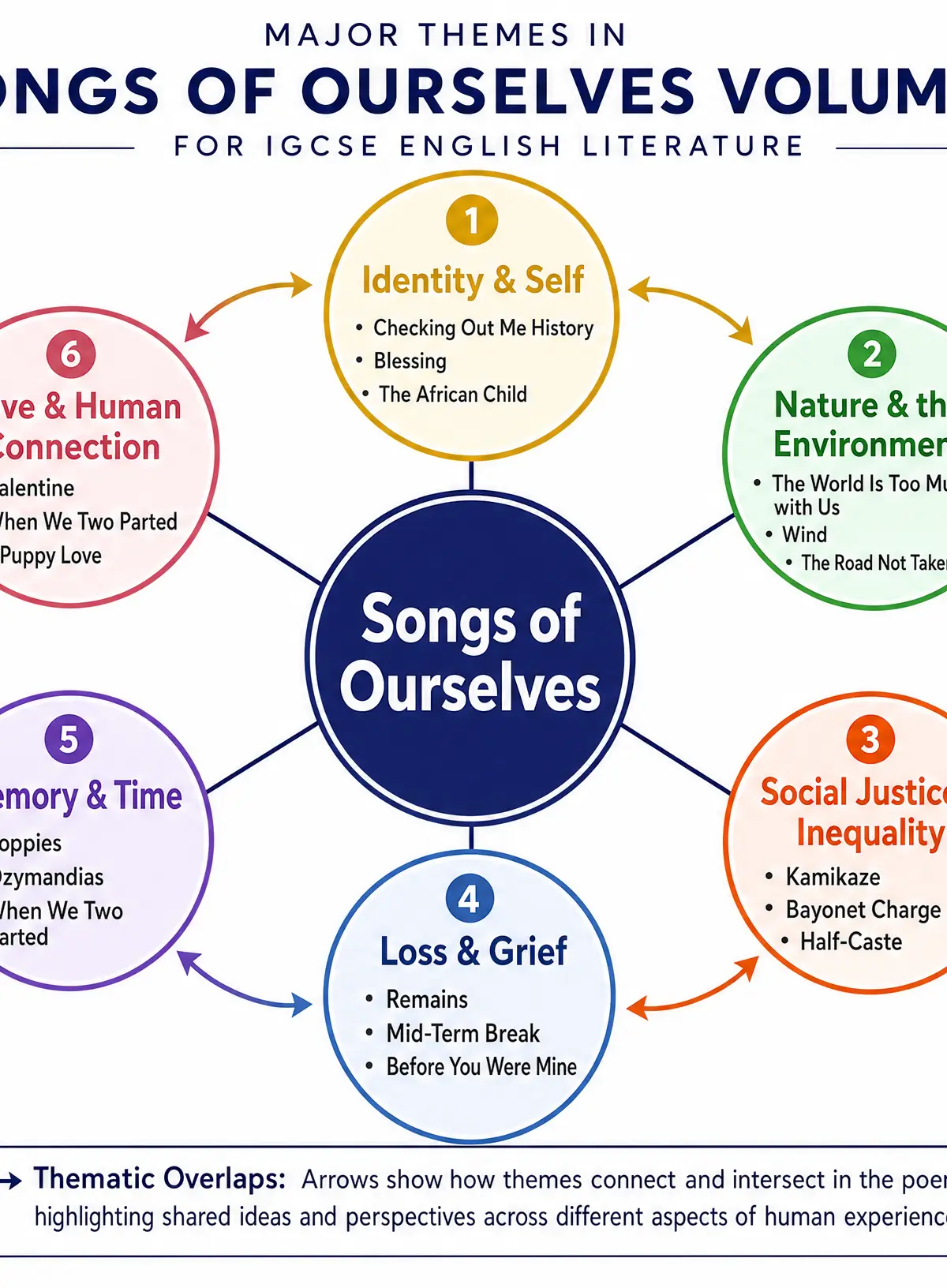
Theme 1: Identity and Self
Identity is a central preoccupation in many of the anthology's poems. Poets frequently explore how personal identity is constructed, challenged, or asserted in the face of societal expectations, cultural heritage, or historical trauma. This theme often manifests through the poet's choice of voice, dialect, and perspective.
Key Quotes:
- "I am the darker brother." (Langston Hughes, I, Too) - The speaker asserts his presence and identity within a divided society, using the metaphor of family to demand equality and recognition.
- "Dem tell me / Wha dem want to tell me" (John Agard, Checking Out Me History) - The use of non-standard phonetic spelling and repetition highlights the speaker's rebellion against a Eurocentric curriculum, reclaiming his own cultural narrative.
Theme 2: Nature and the Environment
The natural world serves as a powerful canvas for exploring human emotion, mortality, and our place in the universe. Nature is rarely just a backdrop; it is often personified, acting as a mirror for the speaker's internal state or as an indifferent force that highlights human fragility.
Key Quotes:
- "The world is too much with us; late and soon," (William Wordsworth, The World Is Too Much With Us) - Wordsworth laments humanity's alienation from nature due to materialism and industrialisation.
- "This is the dark time, my love," (Martin Carter, This is the Dark Time My Love) - The corruption of the natural landscape mirrors the political oppression and violence experienced by the speaker's country.
Theme 3: Social Justice and Inequality
Many poems in the anthology serve as powerful acts of protest, giving voice to the marginalised and critiquing systemic injustice. These poems demand an empathetic response from the reader, often using stark imagery and direct address to confront uncomfortable truths.
Key Quotes:
- "They send me to eat in the kitchen / When company comes," (Langston Hughes, I, Too) - A stark, literal depiction of segregation that serves as a broader metaphor for systemic racial inequality.
- "Blindfold his eyes... / Tie up his hands..." (Martin Carter, This is the Dark Time My Love) - The imperative verbs and violent imagery vividly convey the brutal reality of political suppression.
Writer's Methods
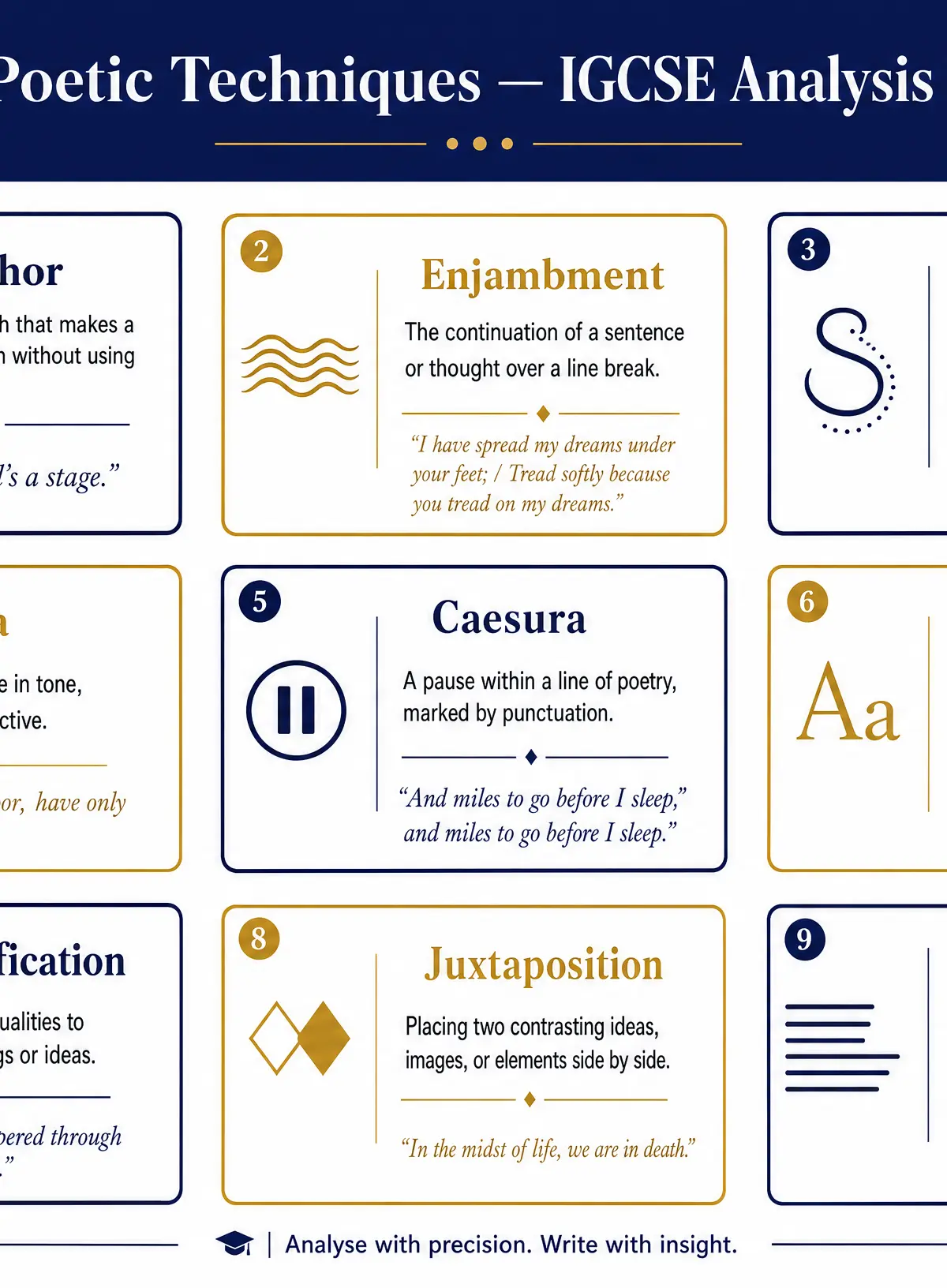
Examiners heavily reward the precise analysis of writer's methods (AO2). This means moving beyond identifying a metaphor to explaining why the poet chose it and how it shapes the reader's understanding.
- Form and Structure: Consider how the physical shape of the poem reflects its meaning. For example, a sonnet's strict structure might convey constrained emotion, while free verse might suggest rebellion or the natural flow of thought. Enjambment (lines flowing into one another without punctuation) can create a sense of urgency, breathlessness, or continuous movement, whereas end-stopped lines can create finality or hesitation.
- Imagery and Metaphor: Analyse the specific connotations of the imagery used. If a poet describes a city as a "machine," what does that imply about the people living within it? Look for recurring motifs or extended metaphors that develop across the poem.
- Sound Devices: Alliteration, sibilance, and assonance are not just decorative; they contribute to the poem's mood. Sibilance (repetition of 's' sounds) might create a sinister, whispering effect, or a soft, soothing tone, depending on the context.
Context
Integrating context (AO3) is vital, but it must be done judiciously. Examiners do not want bolted-on historical facts. Instead, context should illuminate your analysis. For instance, knowing that Wordsworth wrote during the Industrial Revolution helps explain his urgent plea to reconnect with nature. Understanding the political turmoil in Guyana provides essential context for interpreting the oppressive atmosphere in Martin Carter's poetry. Always link contextual details directly back to the specific words and themes of the poem.
Visual Resources
2 diagrams and illustrations
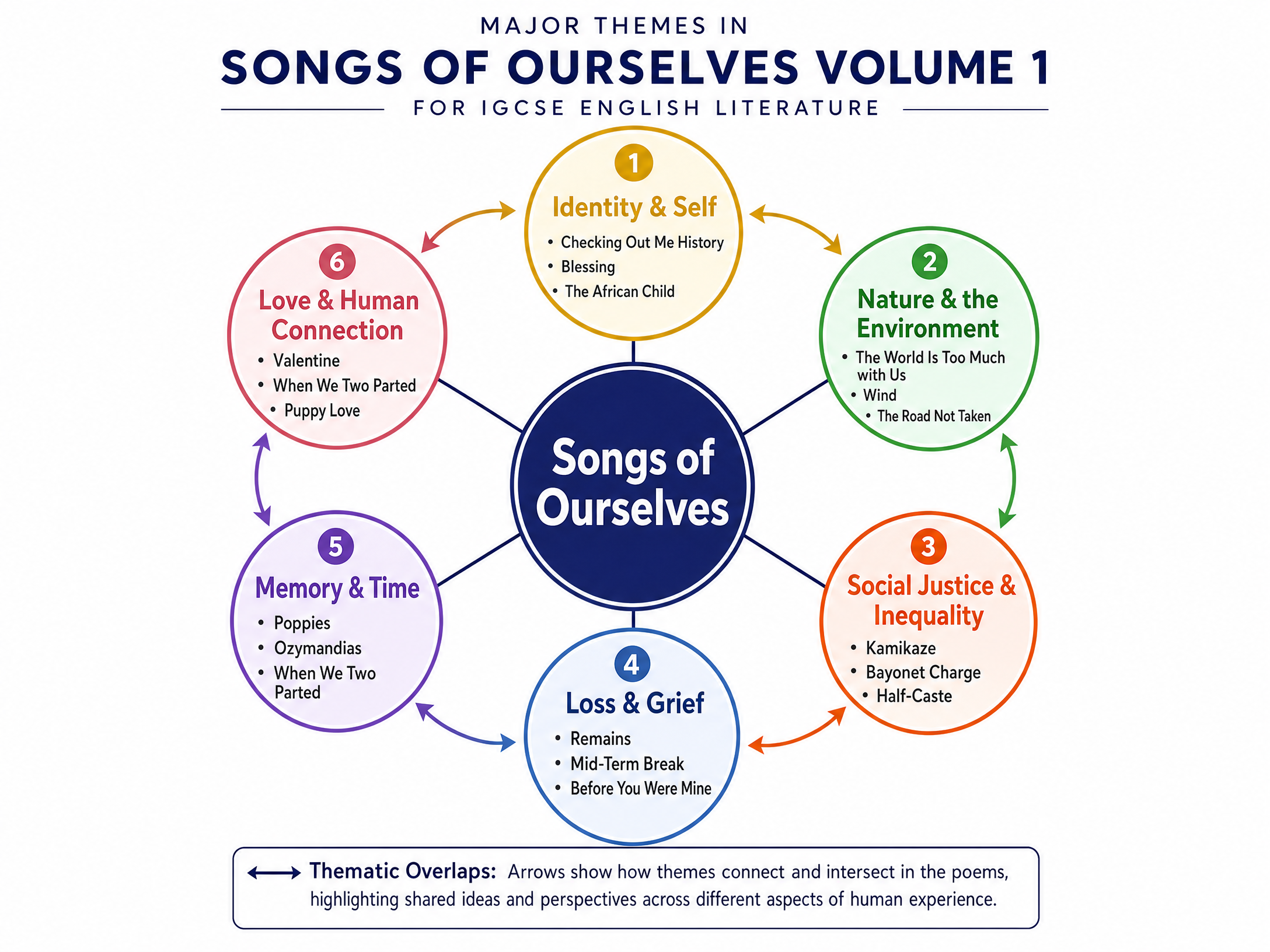
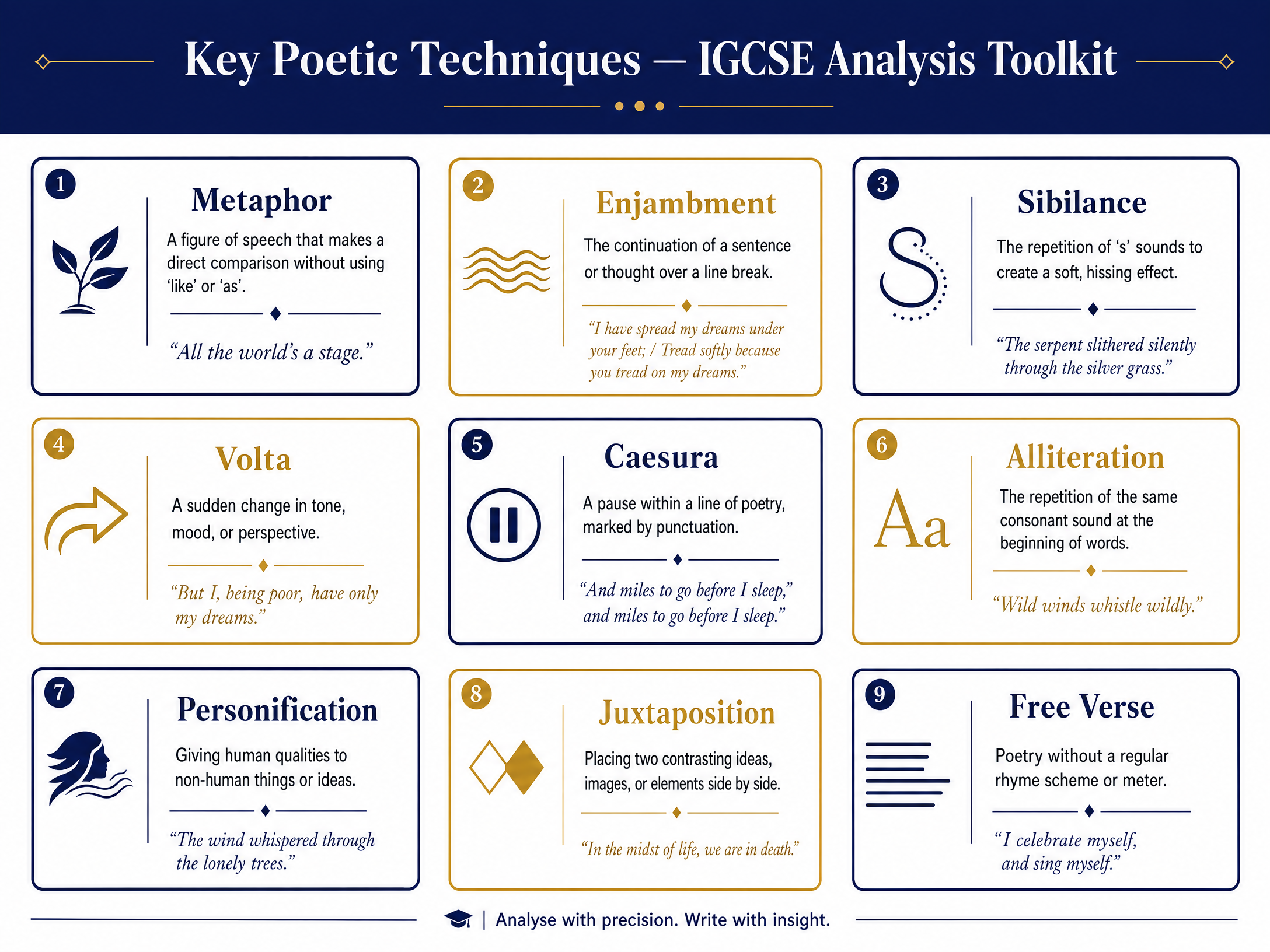
Interactive Diagrams
1 interactive diagram to visualise key concepts
Conceptual Flow Outline
The AO2 Analysis Progression: Moving from identification to perceptive analysis.
Worked Examples
2 worked examples — open one to explore the question and available guidance.
Practice Questions
Test your understanding — click to reveal model answers
How does the poet vividly convey the experience of marginalisation in 'I, Too'? (30 marks + 4 AO4)
Hint: Consider the spatial metaphors (the kitchen vs. the table) and the shift in tone from the beginning to the end of the poem.
Explore the ways in which nature is presented as a powerful force in 'The World Is Too Much With Us'. (30 marks + 4 AO4)
Hint: Look at the sonnet form, the use of personification, and the classical allusions in the sestet.
Compare how the poets explore the idea of cultural heritage in 'Checking Out Me History' and one other poem of your choice. (30 marks + 4 AO4)
Hint: Ensure you use comparative connectives throughout. Don't write two separate mini-essays.
How does the poet create a mood of anxiety and fear in a poem you have studied? (30 marks + 4 AO4)
Hint: Choose a poem like 'This is the Dark Time My Love' and focus on the sensory imagery and structure.